Average Reviews:

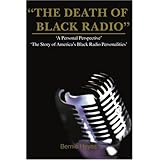
(More customer reviews)Bernie Hayes is a veteran radio man and the author of THE DEATH OF BLACK RADIO. While the book deals to an extent with the economic discrimination faced by blacks in the music industry, it is mainly a memoir of Mr. Hayes' career. And I can safely say you've never read anything like this book. The book's cover says that Mr. Hayes is, among other things, a print journalist. Don't you believe it.
THE DEATH OF BLACK RADIO is hands down the most incompetently written book I have ever read. It is as much as anything a recitation of lists.
We get lists of songs by black recording artists whose airplay suffered when white ownership took over black radio stations. We get lists of singers who stopped by radio stations where Mr. Hayes worked. We even get a list, covering two pages, of notable people who attended his high school as well as a list of the other schools who were his school's main rivals.
There is no coherence of thought in the writing. Mr. Hayes bounces from topic to topic, and then back to the original topic, like an out of control pinball. There appears to have been no effort made to present the material in an even remotely organized fashion. As an example, on pages 26-27, Mr. Hayes starts one of his lists, this one of record distributors in Chicago. After two paragraphs, he shifts with no transition to a totally different subject, the issue of payola in the 50s, which covers four paragraphs. He then, again with no transition, returns to listing the Chicago distributors.
The book does not look good either, in large part due Mr. Hayes' embarrassing lack of understanding of basic punctuation. Examples of this abound on literally every page. Listing some Chicago deejays, he names Pervis 'Blues Man' Spann, Herb 'Kool Gent' Kent, 'Lucky' Cordell, Bill "Doc" Lee, and Ed "Nassau Daddy" Cook. It seems to me that the use of either single or double quotation marks works fine here, but Mr. Hayes does not bother to pick one and stay with it through five names. And later, kicking it up a notch, he refers to Doug (The Leprechaun) Eason.
Neither does Mr. Hayes understand the use of the apostrophe, but, as with the quotation marks, his use and abuse of them transcends mere lack of understanding and approaches absurdity. He refers to Joe's Music Store's.
Later, in another two paragraph list of recording artists, he refers to The Artistics, The Vibrations, The Opals', The Cookies', The Five Keys, The Sharps', and later The Sheppard's. Most people, even if they don't know how to use an apostrophe will at least misuse it consistently.
Then there is the goofiness. Mr. Hayes writes that he and a colleague "calobrated" to put on shows. On page 34 he discusses a trip he took to San Francisco and tells us, "I was always attracted to the locale by the Rice-A-Roni commercials I had seen on television." On pages 20-21, writing about his stay in Louisiana, he says, "I was the only Black DJ in the area so naturally I had the status of prestige." He then writes, "I rode back to Chicago with Marion Walter Jacobs, known as "Little Walter", and his band. His real first name was Marion."
THE DEATH OF BLACK RADIO is self-published and Bernie Hayes should never have allowed this book to be printed as it is. The least he could have done was to give it to a competent and literate proofreader, but he apparently didn't want to bother, preferring instead to foist off on the public a book that looks like it was written by a reasonably well educated 7th grader.
By no means should anyone buy this book, but if you can get it from the library, you might want to take a look at it, because I guarantee you've never seen anything like it.
Finally, the very last sentence of the book, after Mr. Hayes has named those who helped him with the book, reads, "A sincere thanks and please except my love."
I think that says it all.
Click Here to see more reviews about: DEATH OF BLACK RADIO
With over fifty years of experience in journalism and radio, author Bernie J. Hayes delivers a detailed personal account of the history of the Black radio industry.
Since the 1940s, African-American radio personalities have developed, engineered, and urbanized "soul radio". Their influence has helped to shape the history of radio and the recording industry. But even though Black radio personalities at one time provided cultural continuity for the race, record companies and the current hip-hop movement that dominate the business today have encouraged songs with sometimes suggestive and obscene lyrics that cause division.
This cultural shift has impacted the African-American's attempts to gain fairness in the media, a fight that began in the Jim Crow South and lasted through the years of the Black Migration to today. Although there has been a great diversity in the history of radio, the economic motives of some station owners demonstrate how many current practices betray the promises of the Emancipation Proclamation.
With compelling insight into American culture, The Death of Black Radio shares the remarkable journey of the African-American radio experience in America.


0 comments:
Post a Comment